
Understanding the Questions
Understanding the Questions
To do well in the 11+ reading section, children need to understand exactly what each question is asking. This page shows how to spot key words, scan the text for clues and avoid common mistakes. With the right approach, your child can find the correct answers quickly and confidently.
Steps for Understanding Questions

To answer questions correctly, children need to:
- Spot the key words in the question
- Work out what kind of answer is being asked for
- Scan the text to find the right part
- Check the question again before answering
Let’s look at how to do this.
1. Focus on the Key Words
Key words are the most important words in the question. They tell you exactly what kind of information to look for and how to write the answer.
Key words usually include:
- Names or characters
- Specific actions (like leaves, decides, says)
- Feelings or thoughts
- Times or places
- Question words like why, how or which
The key words in the question will help your child find the right parts of the text quickly and confidently.
How to Spot Key Words Quickly
Let’s look at an example:
Question: Why does the girl decide to walk home by herself?
Your eyes might see the whole question at once, but your brain should zoom in on these key words:
- Why – This tells you the question is asking for a reason
- girl – Who the question is about
- walk home – The action we need to explain
So, when you scan the text for the answer, you’re not just looking for any sentence with the girl in it. Instead, you’re looking for one that shows her reason for deciding to walk home.
A Trickier Example
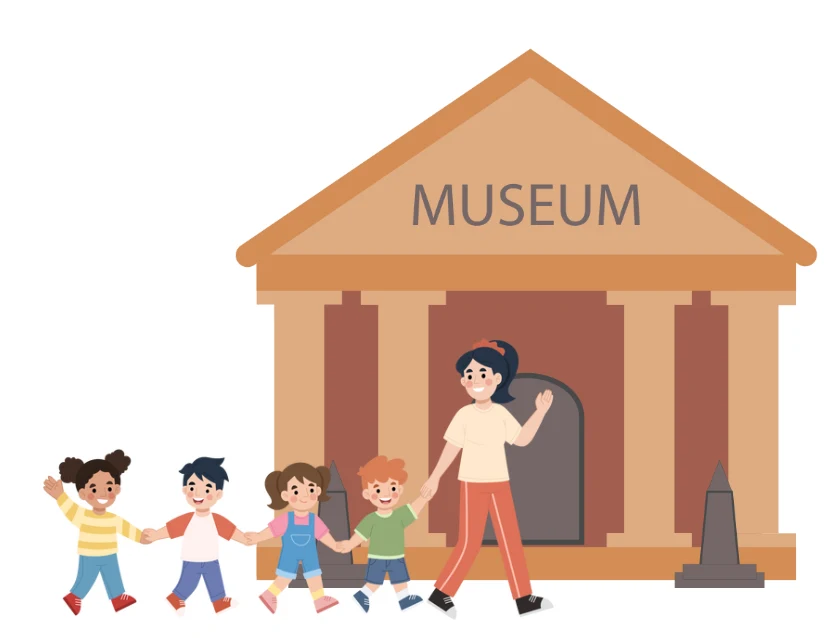
Question: In this text, the author tells us about how the children are feeling. Explain how the author shows that the children are both nervous and excited about their visit to the museum.
This one sounds long and complicated. But if you break it down, the key words jump out and make it much easier to understand:
- Explain how – Describe the methods the author uses, not just point out quotes that show how the children feel
- children – Who the question is about
- nervous and excited – These are the feelings to look out for
- visit to the museum – This tells us to look out for the childrens’ emotions when they visit the museum.
Here’s how the question can be simplified by paying attention to the key words:
How does the author show the children are nervous and excited about the museum visit?
That’s all you’re really being asked. Now, you just need to find clues in the text that match those two emotions. Maybe they fidget, talk quickly or ask lots of questions. These are signs of nervousness or excitement.
Why Do Key Words Help?
If your child learns to spot key words:
- They’ll understand the question straight away
- They’ll save time by going straight to the part of the text that matters
- They’ll be more likely to give an answer that actually gets the mark
Without key words, they’re guessing. With them, they’re searching with a clear map.
2. Understand What the Question Wants
The wording of the question can tell you what sort of answer is needed. Here are some common question words and what they usually mean:
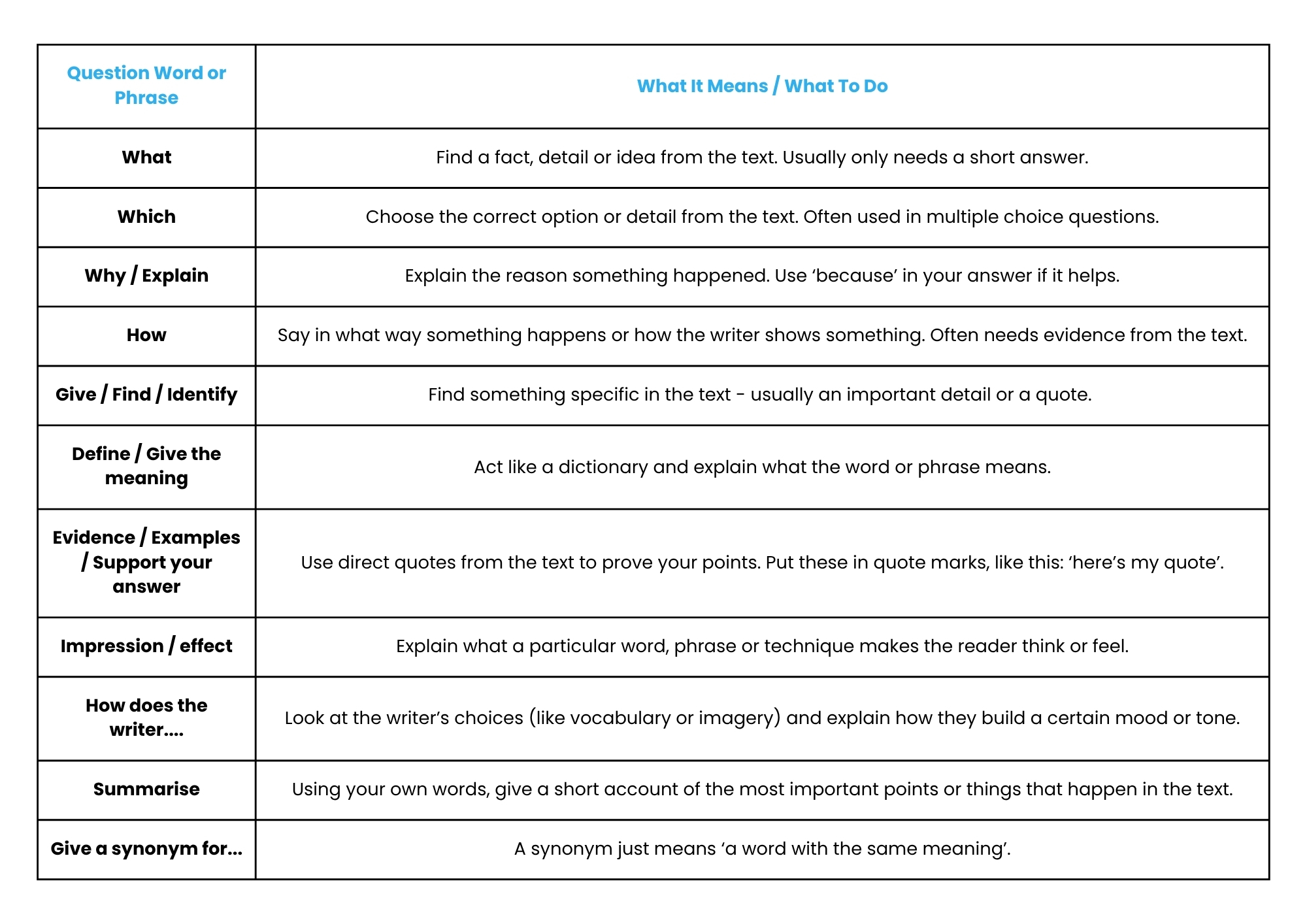
Knowing what the question is really asking helps avoid giving the wrong type of answer. Encourage your child to learn all of the terms and question phrases in the table above.

3. Scan the Text
Key words in questions usually match up with information in the text.
When your child reads the text, they should look for:
- The actual key words that were mentioned in the question
- Words with the same meaning or a similar meaning
- Ideas that reflect the key words:
- If the question is about the character’s actions, look for a paragraph where they do something.
- If the question mentions a setting, go back to where the place is described.
Your child should not have to re-read the whole text to find the answer. Instead, they should scan it to find the right part.
Tip: If your child needs some practice with this, encourage them to do word searches and practice papers to identify key words and find information. This will train their brain to scan words quickly.
4. Double-Check Before Answering
Before writing anything down, it’s worth reading the question again. Make sure that answers to questions match up with what was asked. Children sometimes give answers that are mostly right, but miss one small detail and lose the mark.
How Texts are Organised
Most 11+ texts don’t include any headings, subheadings and other helpful features like images. However, these features can be very helpful when teaching children how to locate information quickly. Try showing your child an online article and asking them to use features like subheadings to find specific pieces of information.

Example Questions
Let’s take a look at an example text, alongside some questions that your child may encounter in their 11+ exam.
The Clockmaker’s Apprentice
Ellie pushed open the dusty shop door, and a bell rang overhead, sharp and sudden. She stepped into the clock shop, her heart fluttering like a trapped bird. The inside was darker than she expected. Hundreds of old clocks ticked and tocked in stubborn unison, lining the walls like watchful eyes.
She had been told Mr Beltram was strange, and the shop certainly felt it. But Ellie was used to oddness. She stepped forward with quiet confidence, ignoring the tickling sense that the clocks were somehow observing her.
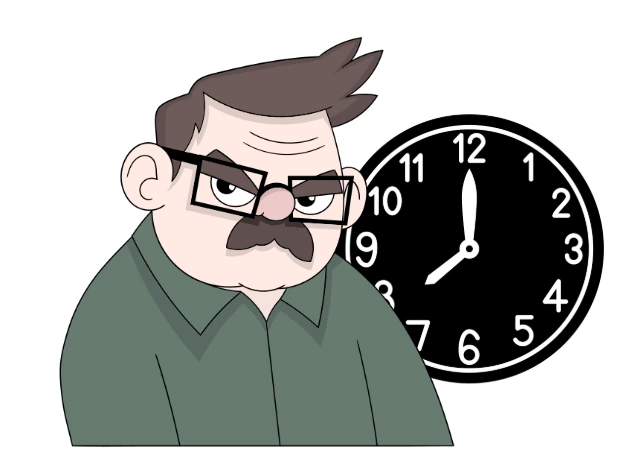
Behind the counter sat a thin man with silver spectacles and a long moustache that curled upwards at the ends. He didn’t look up from the tiny gears he was adjusting with tweezers.
‘I’m here about the apprenticeship,’ Ellie said.
Mr Beltram sniffed. “You’re late,” he muttered, without looking up from his desk. He wound the golden clock on his desk with sharp, precise movements.
He placed the gears in a velvet-lined box and finally looked up. His eyes flicked over her like she was a pocket watch he could take apart and understand in seconds. Ellie stood straighter.
‘We begin at six sharp. No excuses. No late arrivals. And no touching anything unless I say so. Understood?’
Ellie nodded. Her throat was dry, but her voice stayed steady. ‘Understood.’
Mr Beltram raised one eyebrow. ‘Then perhaps,’ he said, ‘you might just do.’
Let’s start with a simple question…
Q1 – Which phrase suggests that Mr Beltram is strict about timekeeping? (1 mark)
1- Find the key words in the question:
- Phrase = look for a short group of words
- Suggests = it doesn’t have to say it directly – we’re looking for a hint or clue
- Strict about timekeeping = shows he’s serious or fussy about time and schedules
2- Skim the text for anything about Mr Beltram and time:
‘“You’re late,” he muttered, without looking up from his desk.’
…and that’s our answer!
The fact that he comments on her being late straight away and without looking up shows he cares a lot about time and is strict about it.
Q2 – Choose the best word to describe Ellie at the start of the passage:
- brave
- delighted
- nervous
- impatient
Explain your choice using the text.
(2 marks)

1- Find the key words in the question
The most important words here are:
- ‘best word’ – the right word needs to be chosen from the list of options
- ‘Ellie’ – who the question is about
- ‘start’ – only focus on the beginning of the text
- ‘explain’ – give a reason for your answer
- ‘using the text’ – use a quote to support your reason
2- Scan the text for clues
Go to the start of the passage:
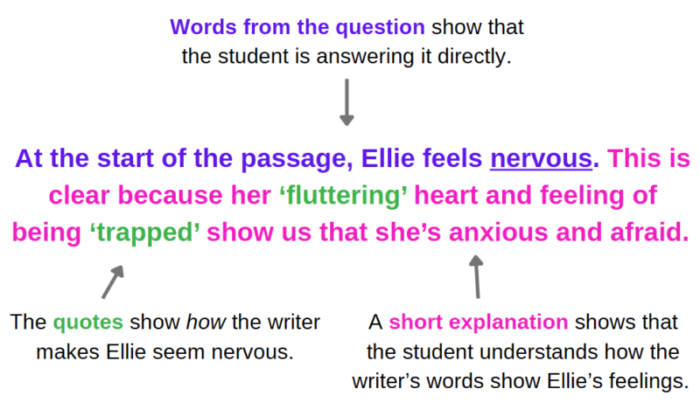
‘She stepped into the clock shop, her heart fluttering like a trapped bird’
This sentence shows how Ellie is feeling at the start of the text. Although Ellie has ‘quiet confidence’ later on in the text, she’s not so confident when she first steps into the shop.
3- Use evidence to explain the answer
Challenging Question:
Q3- How does the writer make the clocks seem alive? Explain your answer using evidence from the text. (3 marks)
1- Find the key words in the question
The most important words here are:
- ‘how’= What method does the writer use? Think about the writer’s word choices and techniques like similes, repetition or alliteration
- ‘clocks’ = Scan the text to find this key word
- ‘alive’ = Clocks might be mentioned more than once, so specifically look for anything that gives the idea of them seeming alive
- ‘explain’ = Give a reason behind your answer
- ‘evidence’ = Use quotes from the text
2- Scan the text for clues
We’re looking for how the writer describes the clocks.
In the second paragraph:
‘Hundreds of old clocks ticked and tocked in stubborn unison, lining the walls like watchful eyes.’
3- Match ideas, not just words
The phrase ‘like watchful eyes’ is a simile, comparing the clocks to eyes that can watch.
The idea that the clocks are ‘stubborn’ gives them human-like personalities. The writer is using personification here.
In this way, the writer makes the clocks ‘seem alive’.
4- Write the answer
Using words from the question will help you to make sure that you’ve got the right idea…
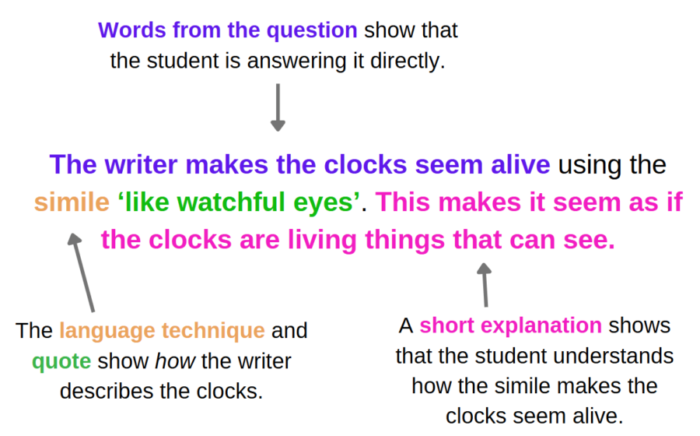
For a more complicated question like this one, it’s especially important to pay attention to the key words in the question.
The three marks for this question are awarded for:
- Identifying the technique (simile or personification)*
- Choosing the right quote (‘like watchful eyes’ or ‘stubborn’)
- Giving a suitable explanation
*If you haven’t heard of these techniques before, head over to the ‘Language Features’ page for more information.
Important note: More selective schools will challenge children with difficult questions like this one. Check past papers for your chosen school to gauge difficulty levels.
So far, we’ve considered questions that require children to retrieve specific information, understand texts or interpret the effects of language. Most of the reading questions in your child’s 11+ exam are likely to focus on these skills, but there are many other types of questions too.
See our other revision pages for guidance on questions requiring children to spot word classes, define words, give synonyms and correct spelling, punctuation and grammar errors.
Understanding the Questions Example Questions
Click here to see the text!
Q1- How does the writer describe the weather? Use evidence from the text to support your answer.
The writer describes the weather as very rainy and cold. They describe how ‘the rain fell in relentless sheets’ and there was a ‘chill’ in the air.
Look carefully at the key words in the question. Focus on the parts of the text where the writer describes the weather. Don’t forget the evidence (quotes) in your answer!
Q2- Choose the best word to describe Mr Grey in the text:
A) Frightened
B) In control
C) Upset
D) Confused
Use evidence from the text to explain your answer.
B) In control
The writer says that ‘Grey reacted at once’ when he grabbed Mr Price and he spoke ‘evenly’ and ‘sharply’. This shows he is in control of the situation.
This question tells you to focus on Mr Grey, so don’t focus on the other characters.
As well as choosing the right option, the question tells you to explain your answer and use evidence from the text. Make sure you use quotes to say why it’s the right answer.
Q3- The writer describes the ‘relentless sheets’ of rain and the ‘chill’ of the night. Why do you think the writer sets the scene in this way?
To build a sense of mystery.
OR
To build tension.
OR
To show that bad things are going to happen.
The question asks why the writer used this description. Dark, cold and stormy settings are often used by writers to build tension, mystery or negativity.
Q4- What impression do you get of Mr Price?
He is a criminal / suspicious / reckless / afraid / angry / upset.
Look for what Price says and how he behaves. He says ‘You’ve no idea what you’re interfering with’ and he tries desperately to escape from Grey. His attempt to escape suggests he’s done something wrong, and he seems to be afraid, upset and angry when he gets caught.
Writers often try to get their readers to think and feel things, so some questions might ask for your own impressions.
Q5- How does the writer build tension in this extract?
Correct answers:
- The description of the dark, cold and wet setting is ominous
- The dicovery of the bottles and footprints reveal clues
- The scene is very active as Grey chases Price and catches him
- More information about the mystery is revealed when Grey describes the ‘curious picture’ in the chemist’s shop
- Price’s panic builds tension as the reader wonders what he has done
- At the end of the text, the writer suggests that the mystery is far from solved
Tension is built when the writer makes something seem important or scary for the reader.
Q6- What do you think will happen next in the story?
Grey and Drake will interrogate Price at the police station
OR
Price will escape
Use what you know so far to make an educated guess about what will happen next. We know that Grey has caught Price and it is mentioned that he will take him to the station. We also know that Price has tried to escape once, so he might try to do so again.