
3D Shapes
Shapes
shapes are different from shapes because they have length, width and depth. You can imagine a shape made from a block of wood.
Your child will need to recognise properties of different shapes, understand how nets fold to make shapes, and know how to find the volume of cubes and cuboids.
Faces, Edges and Vertices
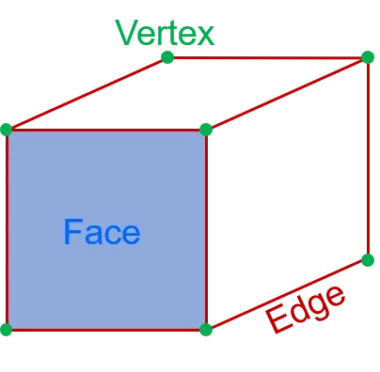
A face is a flat surface on a shape.
An edge is a straight line where faces meet.
A vertex is a corner of a shape, where edges meet. The plural of vertex is vertices.

Common Shapes

Cubes and cuboids have faces, edges and vertices.

A square based pyramid has faces, edges and vertices.
A triangular based pyramid has faces, edges and vertices.

All prisms have the same face at each end.
A triangular prism has faces, edges and vertices.
A pentagonal prism has faces, edges and vertices.
Volume of Cubes and Cuboids
Volume is the space inside a shape.
The volume of a cube or cuboid is length width height
Volume is measured in units cubed, e.g. or
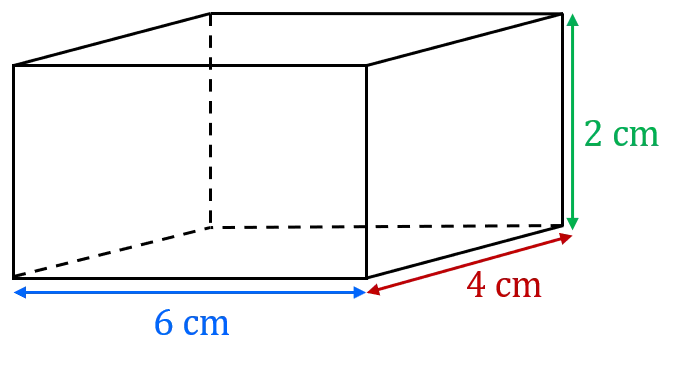
Example: Work out the volume of the cuboid.
Length
Width
Height
Volume
Nets
shapes can be made using a net. A net is a shape that folds up to become a shape.
Imagine cutting these shapes out of card and folding them up to make the shapes:

Example: Nets

Draw a sketch of the shape made using this net:

Encourage your child to look at the shape and size of the faces on the net.
We can see the shape has three rectangular faces, and identical triangular faces at each end.
So from the common shapes we have seen, it must be a triangular prism.
3D Shapes Example Questions
Question 1: How many vertices does a triangular prism have?
[1 mark]
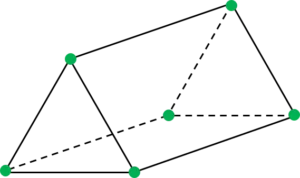
Vertices are corners, so a triangular prism has vertices.
Question 2: What is the volume of a cube with side lengths of ?
[1 mark]
On a cube, all edges are the same size, so the length, width and height are all .
So the volume is
Question 3: This tank is full of water. The volume of the water is .
What is the height of the tank?

[2 marks]
We know volume is length width height.
So height
Simplifying, height, so the height must be
Question 4: Which is the correct net for a cube?

[1 mark]
A cube has six square faces, so must be option .
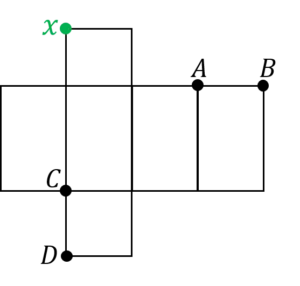
Question 5: Here is a net of a cuboid. Which vertex will join to ?
[1 mark]
The four rectangular faces will wrap around the four edges of the square face, so vertex will join to .