
Angles
Angles
Angles are measured using degrees .
Your child will need to know the different types of angles, and may also be asked to work out a missing angle on a diagram using angle rules.
Types of Angle
There are three types of angle your child needs to know:
- An acute angle measures between and
- A right-angle measures exactly , and is shown by a square symbol on a diagram.
- An obtuse angle measures between and


Angle Rule
Angles around a point add up to
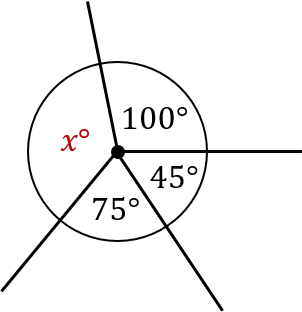
Example: Find the value of angle in the diagram.
All the angles around a central point must add up to
The angles we are given so far add up to
So angle must be
Angle Rule
Angles on a straight line add up to

Example: Find the value of angle in the diagram.
All the angles on a straight line must add up to
The angle we are given is
So angle must be
Angle Rule
Angles in a triangle add up to

Example: Find the value of angle in the diagram.
All three angles in the triangle must add up to
The angles we are given so far add up to
So angle must be
Angle Rule
Angles in a quadrilateral add up to
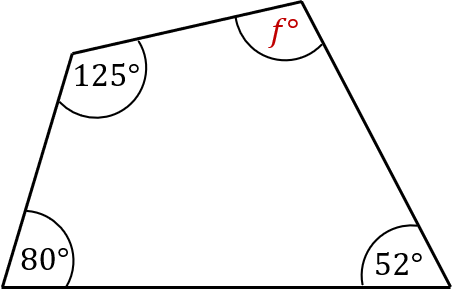
Example: Find the value of angle in the diagram.
All four angles in the quadrilateral must add up to
The angles we are given so far add up to
So angle must be
Example: Finding Missing Angles in a Composite Shape
A composite shape is made up of smaller shapes. Your child may have to use more than one rule to find a missing angle in a composite shape.
Example: Find the values of:
a) Angle
b) Angle
c) Angle
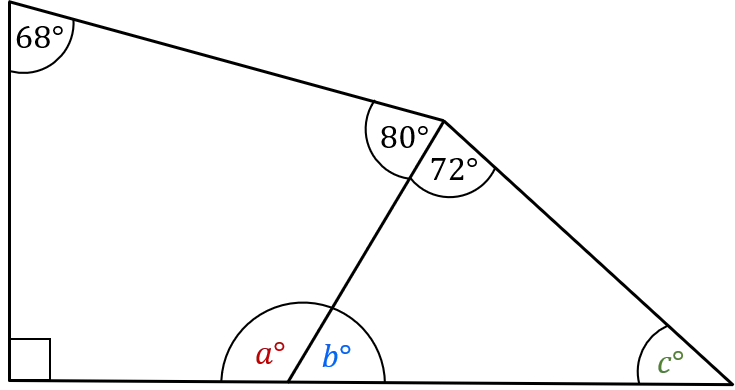
a) The left hand shape is a quadrilateral, and we know the angles in a quadrilateral add up to
The angle with the square symbol must be a right-angle, which is
So we know three angles in the quadrilateral. They add up to
So angle must be
b) We know angles on a straight line add up to
We also know that angle
So angle must be
c) The right hand shape is a triangle, and we know the angles in a triangle add up to
We also know that angle
So we know two angles in the triangle. They add up to
So angle must be
Angles Example Questions
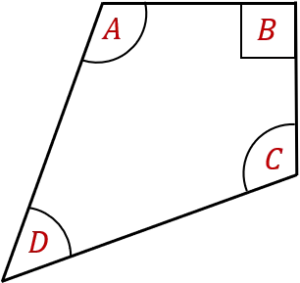
Question 1: Which angle on the shape below is acute?
[1 mark]
An acute angle is bigger than but smaller than , so must be angle .
Question 2: Find the value of angle on the diagram.
 [1 mark]
Angles on a straight line add up to , so
Question 3: Find the value of angle on the diagram.

[1 mark]
Angles in a triangle add up to
The two angles we know add up to
So
Question 4: What is the size of the angle marked between the hands on this clock?

[3 marks]
The angle around the centre point of the clock is
We know there are hours equally spaces around the clock, so the angle between each hour must be
The hands are hours apart.
So the angle between them must be
Question 5: Find the values of:
a) angle
b) angle
c) angle
d) angle
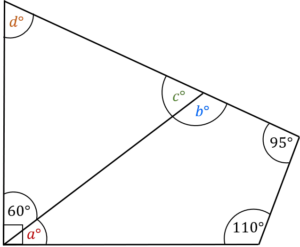
[4 marks]
a) The angle with a square symbol is a right-angle, which is
So
b) The right hand shape is a quadrilateral, and we know the angles in a quadrilateral add up to .
We know three of the angles in the quadrilateral, which add up to .
So
c) We know angles on a straight line add up to , so
d) The left hand shape is a triangle, and we know the angles in a triangle add up to
We know two of the angles in the triangle, which add up to
So