
Factors and Multiples
Factors and Multiples
In their exam, your child may be asked to find prime factors, the lowest common multiple (LCM) and the highest common factor (HCF) of a number or pair of numbers.
In this section, we will show you techniques and examples that you can go through with your child including prime factor trees, so that your child can become familiar with these types of questions.
Prime Factorisation
As the name suggests a prime factor is a factor of a number that also is a prime number.
A prime number is a number whose only factors are and itself. For example is a prime number and the only numbers that divide into it are and .
To find the prime factors of a number your child can use a prime factor tree which is a visual way to see how the number is being broken down into its prime factors.

Example: Using a prime factor tree, find the prime factorisation of .
First, find two numbers that multiply together to make
We have chosen
Next circle any prime numbers that appear, in this case is a prime number so it has been circled. is not prime so we leave that as it is.
Then, do the same for the . Two numbers that multiply to make are and .
Both and are prime so we circle both of them.
The process finishes when at the end of each branch is a prime number that can’t be split up any more. Then, we can write out original number as a product of its prime factors.

Lowest Common Multiple (LCM)
The lowest common multiple of two numbers is the smallest value that is a multiple of both numbers.
Example: Find the lowest common multiple of and
List out the multiples of both numbers.
Multiples of :
Multiples of :
Therefore, we can see the smallest number that appears in both lists is . It is worth noting that also appears in both lists, but in order for a number to be the lowest common multiple it needs to be the smallest number that appears in both lists.
Highest Common Factor (HCF)
The highest common factor of two numbers is the biggest number that is a factor of both numbers.
Example: Find the highest common factor of and
Factors of : and
Factors of : and
Therefore, we can see that the biggest number that appears in both lists is . Like in the previous example about LCM, there are multiple numbers that appear in both lists but is the greatest which makes it the highest common factor.
Example 1: LCM and HCF Using Prime Factorisation
An alternative method for finding the LCM and HCF of two numbers is to use their prime factorisation.
Example: Find the lowest common multiple and highest common factor of and using prime factorisation.
First, let’s find the prime factorisations of the numbers in the question.

Using the prime factor trees we can write the numbers as a product of their prime factors.
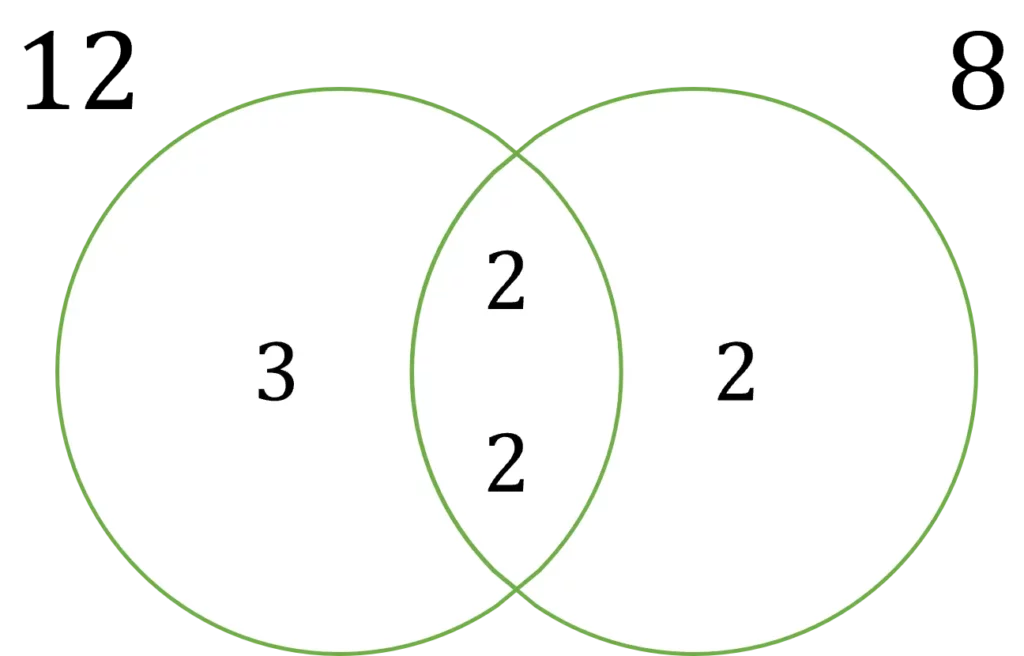
Put the factors into a Venn diagram, the factors that appear in both factorisations go into the middle and the rest in their respective sections.
To find the LCM, multiply all of the numbers found in the Venn diagram.
LCM
To find the HCF, multiply the numbers in the middle section of the Venn diagram together.
HCF
Factors and Multiples Example Questions
Question 1: Find the prime factorisation of:
a)
b)
[2 marks]
a) Draw a prime factor tree for and split up each number until all numbers on the end of the branches are prime numbers. 
Hence, written as a product of its prime factors is:
b) Draw a prime factor tree for and split up each number until all numbers on the end of the branches are prime numbers.

Hence, written as a product of its prime factors is:
Question 2: Holly is hosting a party and is serving burgers to the guests.
Burgers can be bought in packs of and bread rolls can be bought in packs of .
Holly needs exactly the same amount of burgers as bread rolls.
What is the smallest number of packs of each she must buy?
[3 marks]
The first step is to recognise that to find the answer for this question, we first need to find the lowest common multiple (LCM) of and .
Find the prime factor trees of and :
Putting these numbers into a Venn diagram, we can see that the LCM of and is .
Therefore, we need burgers and bread rolls.
Remember, the question asks us how many packs of each item we will need.
packs of burgers
packs of bread rolls.
Question 3: What is the largest whole number that is a factor of and ?
[2 marks]
List the factors of and .
Factors of : and
Factors of : and
The largest number in both of the lists is . So, this is the largest whole number that is a factor of both numbers.