
Multiplication and Division
Multiplication and Division
Multiplication and division are fundamental skills that underpin a lot of questions that your child may get asked on their exam. It is important that they have a good grasp on the techniques used in this section. We will also look at tricks for multiplying and dividing by and .
Multiplying by and
These are some helpful rules for your child to learn to make multiplying easier!
- Multiplying by : move the decimal point place to the right.
- Multiplying by : move the decimal point places to the right.
- Multiplying by : move the decimal point places to the right.
These rules can be generalised for other values such as just move the decimal point to the right the same number of places as the number has zeros after the

Dividing by and
Multiplying and dividing are opposite operations, therefore the rules your child needs to remember for division are the opposite of the rules for multiplication.
- Dividing by : move the decimal point place to the left.
- Dividing by : move the decimal point places to the left.
- Dividing by : move the decimal point places to the left.
Like with the rules for multiplication these rules can be generalised for other values… just move the decimal point to the left the same number of places as the number of zeros after the .
Example 1: Multiplication Using a Written Method
Your child can use a method called the written method to multiply large numbers or decimals.
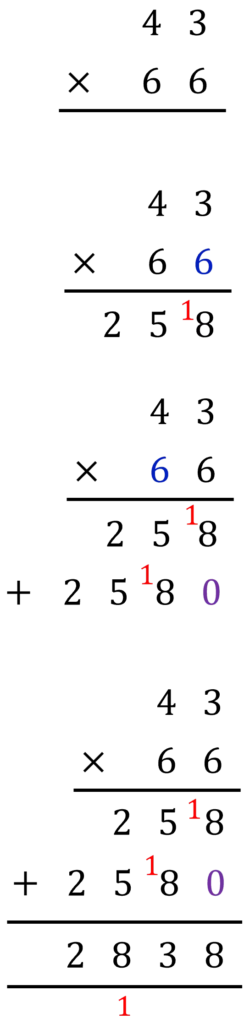
Calculate
Step : First, write the numbers one above the other making sure the units, tens and hundreds columns line up. In this case, both numbers are two digits so can be lined up quite easily.
Step : Next, multiply the digit in the units column of the bottom number by every digit in the top number.
The is carried over as is greater than .
Don’t forget to add on the that has been carried over!
Therefore,
Step : The next row is a little different, we are now multiplying all the digits in the top number by so we must add a to the units column before we begin to multiply.
Now, we can treat it as before and multiply each digit by .
Remember to carry the !
Therefore,
Step : Add these values using the column method for addition discussed in an earlier topic.
So,
This method can also be used to multiply numbers with decimal points. A good thing for your child to remember is to always make sure the decimal points of the numbers they are multiplying together are lined up correctly.
Example 2: Bus Stop Method for Division
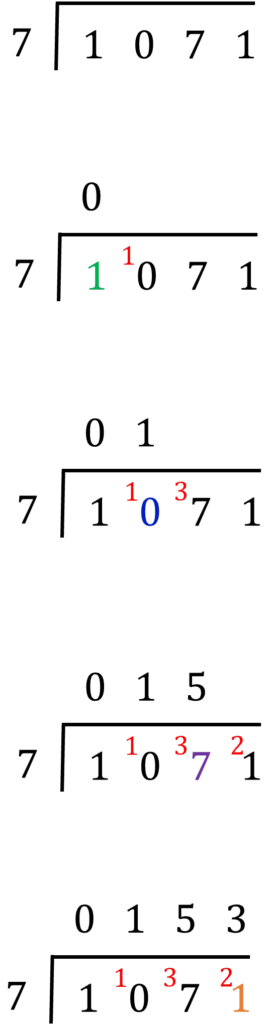
The bus stop method is a memorable way for your child to divide numbers and gets its name as it looks a bit like the number is waiting inside a bus stop.
Calculate
Step : Set up the bus stop. The number we are dividing by, in this case , goes outside the bus stop and the number we are dividing into, in this case goes inside the bus stop.
Step : Next, see how many times divides into . is less than so divides times. A goes above the on the bus stop and the gets carried to the next digit.
This means our next number to divide into is not but is .
Step : Next, how many times does divide into ? Well so the answer is once with leftover.
Step : Then, how many times does divide into ? Well so the answer is times with leftover.
Step : Finally, how many times does divide into ? Well so times exactly.
Therefore,
Multiplication and Division Example Questions
Question 1: Calculate the following:
a)
b)
c)
[3 marks]
a) Multiplying by means we move the decimal point places to the right.
So,
b) Dividing by means we move the decimal point places to the left as there are zeros after the .
So,
c) Multiplying by means we move the decimal point place to the right.
So,
Question 2: Michael buys packs of chocolate bars.
Each pack contains individual bars and each individual bar costs
How much money does Michael spend on chocolate bars altogether?
[2 marks]
Total number of individual chocolate bars bought:
bars
Then find the total cost of individual chocolate bars.
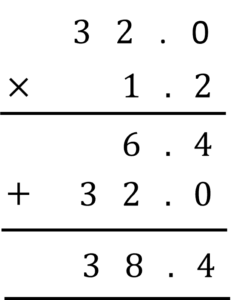 Total cost:
Question 3: Catherine has cupcakes that she needs to to in boxes to be sent to a bakery.
Each box can fit cupcakes.
How many boxes will she need to transport all of the cupcakes to the bakery?
The calculation needed is:

Therefore divides times into with a remainder of . This means that the numbers don’t divide exactly.
boxes will hold cupcakes but there will be still be cupcakes without a box.
Therefore, boxes are needed to transport all of the cupcakes to the bakery.