
Number Basics
Number Basics
There are many different types of numbers that you and your child may come across when revising and it’s important that you can recognise properties of numbers. These types of numbers include odd and even numbers, negative numbers, whole numbers, prime numbers and square numbers.
Even or Odd Numbers
A whole number can either be odd or even.
An even number is a whole number that can be divided by . For example is an even number as which is a whole number.
An odd number is a whole number that can’t be divided by . For example is an odd number as which is not a whole number.

Positive and Negative Numbers
Numbers can also be either positive, if they are greater than or negative, if they are less than .
A number line can be used to help visualise the difference between positive and negative numbers.
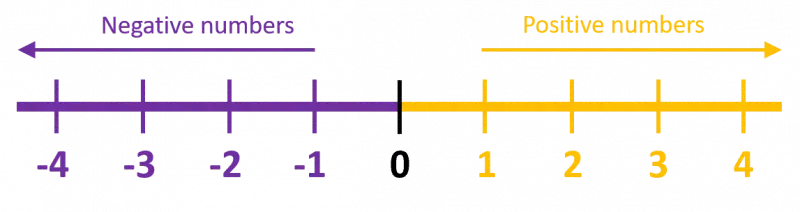
On the left of the number line you can see the negative numbers and on the right you can see the positive numbers. Number lines can be used to show how big a number is in comparison to another number.
On the number line above is the biggest number and is the smallest number.
Factors and Multiples
A factor of a number is a whole number that divides into that number.
A question may ask your child to find common factors of two numbers. This can be done by listing the factors of both numbers and identifying numbers that appear in both lists.
A multiple of a number is found by multiplying a whole number by another whole number. The exam may ask your child to find common multiples of whole numbers. In a similar way to finding common factors, common multiples can be found by listing multiples of each number and identifying numbers that appear on both lists.
Example 1: Common Factors
Find the common factors of and .
[1 mark]
Factors of
Factors of
Common factors of and are numbers that are found in both lists.
Common factors are
Prime Numbers
Prime numbers have exactly two factors, and themselves.
For example is a prime number as the only whole numbers that divide into it are and .
- is not a prime number as it only has one factor.
- The smallest prime number and only even prime number is .
- The ten smallest prime numbers are: and .
Square and Cube Numbers
If you multiply a whole number by itself then you get a square number. There are a few different ways that square numbers can be written.
For example squared or , so is a square number.
Some handy notation that you might see uses indices to write square numbers e.g. , as shown this is still equal to .
Cube numbers are similar to square numbers except a whole number is multiplied by itself twice.
For example cubed would be so is a cube number. Similar notation can be used to express cube numbers e.g.
Roman Numerals
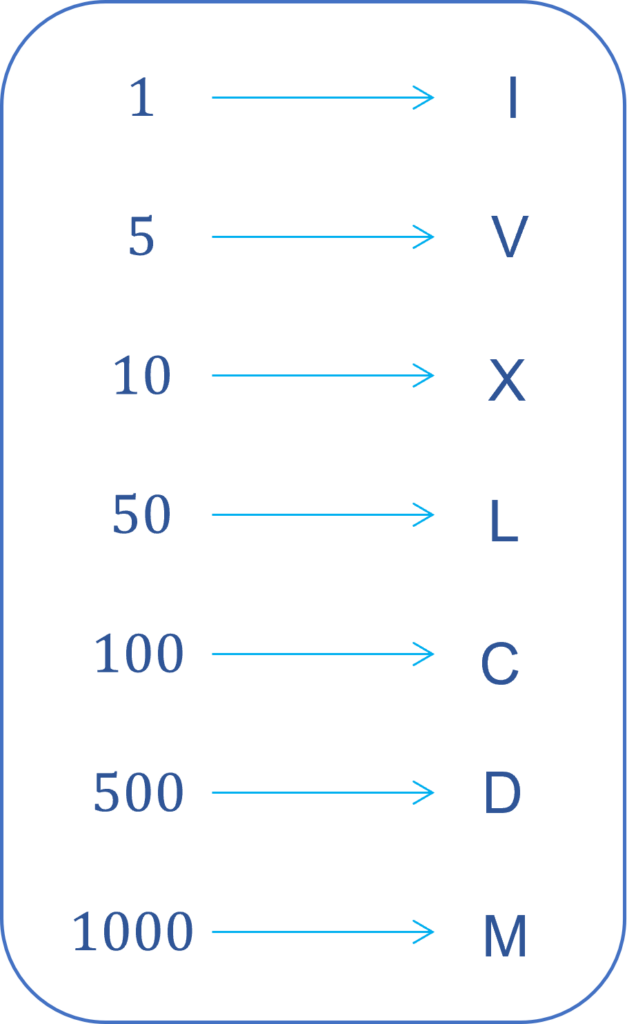
Roman numerals use letters that represent certain numbers and are then used to make up all of the other numbers.
The Roman numerals that your child is expected to be familiar with are seen to the right.
Some numbers are added together to produce higher numbers.
For example III in Roman numerals and XI in Roman numerals.
Other numbers are represented as subtractions if they are s or s.
For example IXX.
Commonly years are represented by Roman numerals so it is important your child is comfortable representing higher numbers in Roman numerals.
Example 2: Writing years as Roman numerals
a. Write the year in Roman numerals.
[1 mark]
MDXXIX
b. Write the number MCMXVIII in digits.
[1 mark]
MCM
XVIII
So, putting them together MCMXVIII
Number Basics Example Questions
Question 1: Sort the following numbers into the table.
[1 mark]
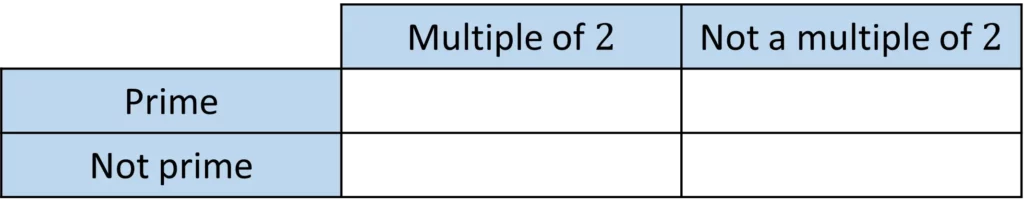
Remember, is the only even prime number, so is the only number in that section of the table. 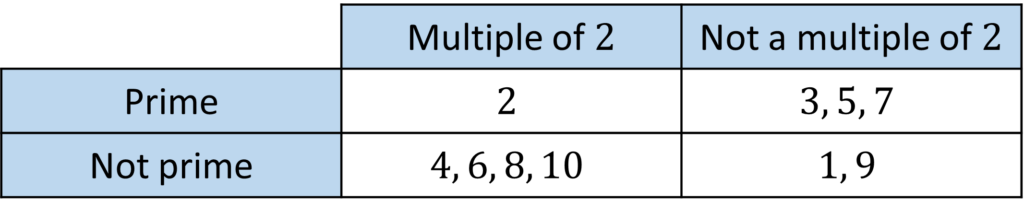
Question 2: Using the number line, find the difference between and .

[1 mark]

As shown on the number line above, there are jumps between and Therefore the difference between and is .
Question 3: What is the sum of the prime numbers between and ?
[1 mark]
The prime numbers between and are:
and
Add these numbers together to work out the sum.