
Place Value
Place Value
Place value is all about understanding what each digit in a number really means. It helps you see the difference between numbers like and , and it makes tricky things like rounding and decimals much easier to understand. Once you know how place value works, you’ll find it quicker to add, subtract, multiply and divide.
What Is Place Value?
Place value helps your child understand what each digit in a number really means. For example, in the number , the means , because it sits in the hundreds column.
Whole Numbers
Each digit in a number has a different value depending on its place. The main columns your child needs to know are:
- Millions
- Hundreds of thousands
- Tens of thousands
- Thousands
- Hundreds
- Tens
- Ones (sometimes called units)
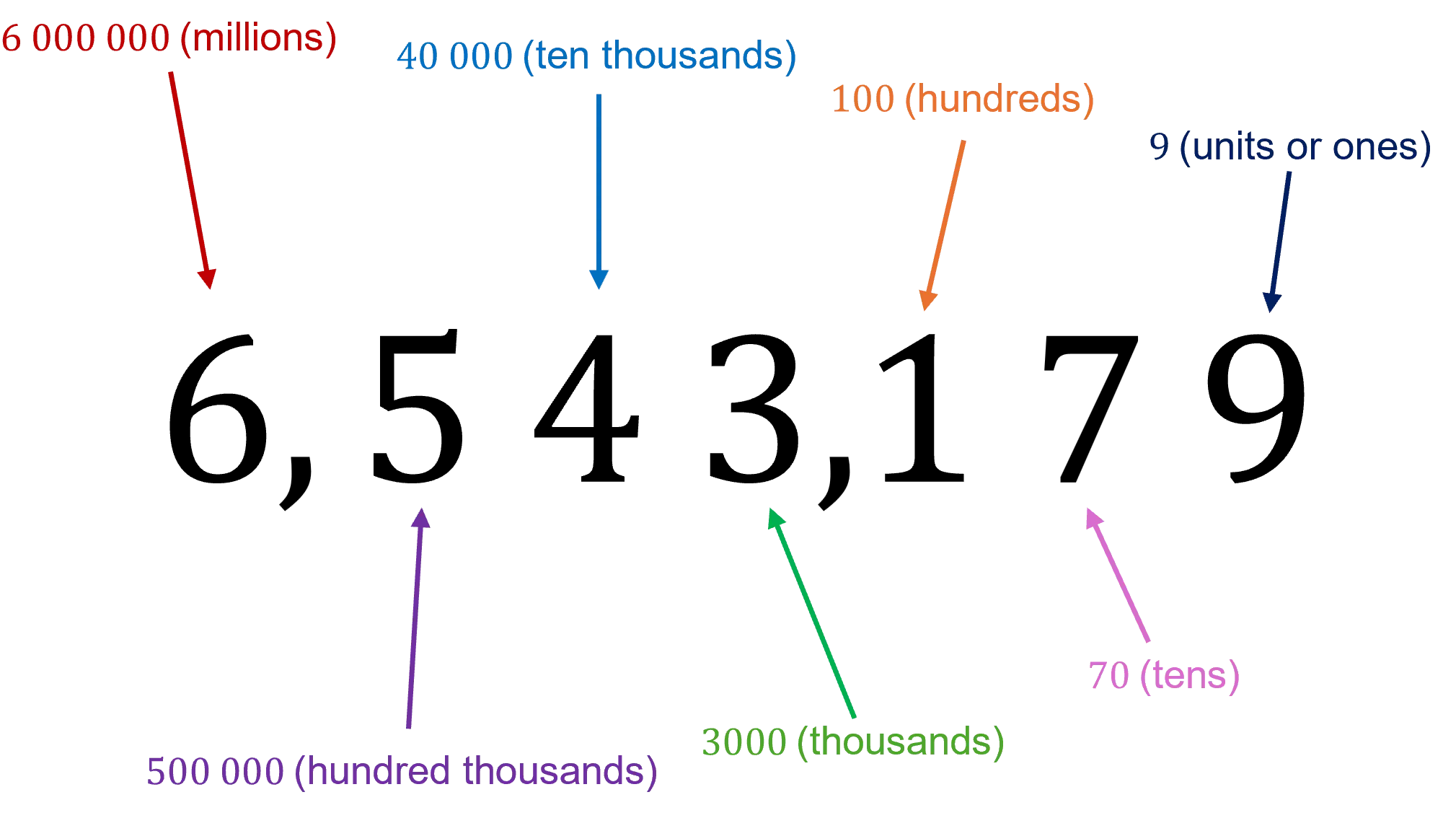
The example above shows what each digit is worth in the number . This number can be spoken in words as:
six million, five hundred and forty–three thousand, one hundred and seventy–nine
- Always start from the right-hand side when placing digits in columns
- Each place is times bigger than the one to the right
- Whole numbers have a greater value when they have more digits e.g. is greater than because it has a thousands digit.
- To work out the bigger number between whole numbers with the same number of digits, you will need to look at the value of each digit starting from the left e.g. is greater than because the hundreds digit is larger.

Decimals
Your child will also need to understand place value in decimal numbers, especially for the 11+.
Here’s how to explain it:
In the number
- The is in the ones place
- The is in the tenths place
- The is in the hundredths place
- The is in the thousands place
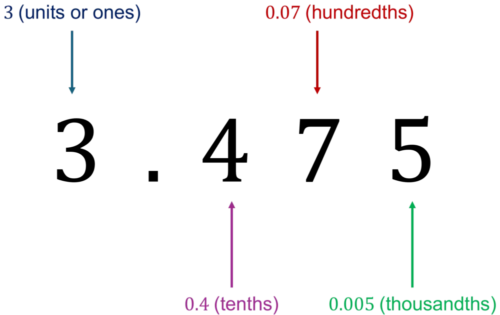
Each digit is worth times as much as the digit to the right. For example tenths hundredths
Number Lines
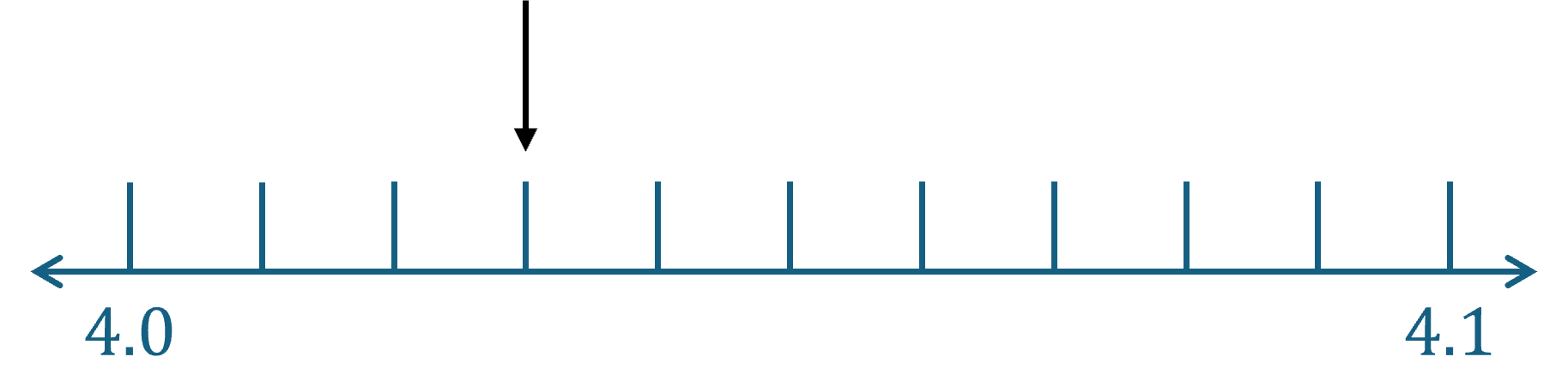
What number is the arrow pointing to on this number line?
Let’s start by looking at the two numbers at the ends of the number line. It starts at and ends at , so we know the arrow must be pointing to a number between those two.
Now count how many spaces the number line is divided into. There are equal parts between and . That means each step is worth – these are called hundredths.
Next, count how many steps the arrow is from . If the arrow is pointing to the third mark, then we just do:
So, the arrow is pointing to .
Example
Ella, Noah, Grace, Ben and Ava all raced one lap around the track. They recorded their times in seconds:

Who drove the quickest?
-
To find out who was the quickest, we need to look for the shortest time, in other words, the smallest number in the table.
Let’s first look at the tens and units.
-
Noah and Ben have times starting with , which is bigger than , so we can rule them out.
That leaves Ella, Grace and Ava, who all have times starting with .
-
Now look at the tenths in their times:
-
Ella has tenths
-
Grace has tenths
-
Ava has tenths
Grace has the smallest number of tenths, so her time is the shortest.
Grace was the quickest.
Place Value Example Questions
Question 1: Which of these is the largest number?
[1 mark]
Look at the whole number part (the number before the decimal point).
All of the numbers start with , so we can’t decide yet, they are all in the s.
Now look at the tenths digit (the first number after the decimal point):
The tenths digits are:
, , , ,
So we can now rule out the numbers starting with tenths, because tenths is bigger.
That leaves us with:
and
Next, compare the hundredths digit (the second digit after the decimal):
Now we compare and . Since is greater, we know:
is the largest number.
Question 2: What is the value of in ?
[1 mark]
The is th digit from the right, meaning it’s in the thousands column.
Therefore, the value is
or six thousand
Question 3: What is the value of in ?
[1 mark]
The is the second digit from the right of the decimal point, meaning it is in the hundredths column.
Therefore, the value is
or three hundredths