
Ratio and Proportion
Ratio and Proportion
Ratios are used to compare how much of one thing there is in comparison to how much of another thing there is. Proportion is a similar concept but is used to compare how much of one thing there is in comparison to the whole.
These concepts can be tricky for your child to get to grips with as they are similar. Work through these examples with your child to help familiarise them with the concepts.
Ratio
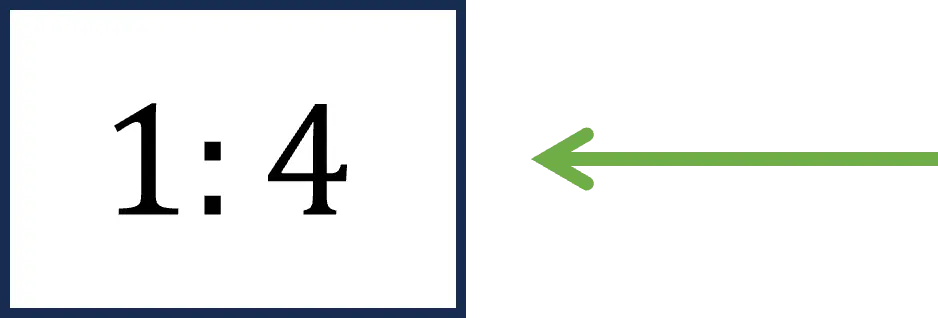
A ratio is a written as and is said ‘one to four’.
This is a ratio in its simplest form as there is no number that will divide into both numbers.
To form a ratio of purple circles to red triangles count the respective shapes in the image.

There are purple circles and red triangles.
Now, you can help your child to form the ratio of circles to triangles.
Unlike the previous example this ratio is not in its simplest form. Both values can be divided by , so if we divide both sides of the ratio by , we can find the ratio in its simplest form.
Looking back at the image, we can group the shapes to see that there is purple circles then red triangle.

So, you can see that for every purple circles there is red triangle. This is the information that the ratio is telling us.

Example 1: Ratio
Nigel and Sally split up some prize money.
Nigel gets and Sally gets .
What is the ratio of the amount of money Nigel gets to the amount of money Sally gets in its simplest form?
[2 marks]
First, form the initial ratio with the values in the question.
Divide both values by to begin to simplify the ratio.
This ratio can be simplified further as both values are divisible by .
Now, the ratio is in its simplest form and this is our final answer.
Proportion

Proportion refers to how much of one thing there is in comparison to the whole. In the example to the right, the refers to the whole and of those one of them has a certain property.
Proportional statements convey the same information as a fraction. The statement in every is the same as saying .
Example: The proportion of blue squares in the image below is in
This is the same as saying of the squares are blue.

This example demonstrates to your child how ratio and proportion are different. The proportional statements informs us that for every squares, of them is blue.
The ratio will tell us how many blue squares there are in comparison to the number of green squares.
The ratio of blue squares to green squares is .
Example 2: Proportion

Your child may come across similar shapes in relation to ratio. To get the side lengths of the bigger shape multiply by a number called the scale factor. This can then be used to find the ratio between the sides of the shape.
Example: The two rectangles on the right hand side are similar shapes.
a) Find the ratio between the pairs of sides of the the rectangles.
b) Find the value of
a) The pair of sides labelled and can be written as a ratio then simplified.
Both of the numbers are divisible by .
The ratio can’t be simplified further so, it is the ratio in its simplest form.
b) Now, using the ratio we can apply it to the other pair of sides to find .
Substituting in the values for the other pair of sides we see that the ratio becomes:
By finding the scale factor from the simplified ratio to the newly formed ratio, we can find the value of .
Scale factor:
Now applying the scale factor, we can find .
Ratio and Proportion Example Questions
Question 1: Divide the following numbers into the ratios.
a) in the ratio
b) in the ratio
[4 marks]
a) Total parts in the ratio
One part of the ratio will equal
parts
parts
Split into the ratio the answer is
b) Total parts in the ratio
One part of the ratio
parts
parts
Split into the ratio the answer is
Question 2: The rectangles below are similar shapes.
Work out the missing length, on the larger rectangle.
[3 marks]

First, find the scale factor using the pair of sides, and .
Scale factor
Using the scale factor, find the missing side:
Question 3: Jonathan, Omar and Charlotte share .
Jonathan receives , Omar receives and Charlotte receives the rest.
Find the ratio of the money received by Jonathan to money received by Omar to money received by Charlotte in its simplest form.
[3 marks]
First, find how much money was received by Charlotte.
received by Jonathan and Omar.
Charlotte received
Next, form the ratio of the money they received.
Each of the numbers in the ratios is divisible by .
So, the final simplified ratio is: